
The SIDS Centre of Excellence, established through the Antigua and Barbuda Agenda for SIDS (ABAS) 2024–2034 is a SIDS-led institution that translates global commitments into national and regional delivery. The Centre supports coordination, technical alignment, and long-term capacity across Small Island Developing States.
The CoE is already operational and actively delivering support, even as its systems and platforms continue to scale. The Centre is functioning both as a physical convening space in Antigua and Barbuda and as a distributed institutional platform working across regions. It is already supporting SIDS-focused convenings, coordinating data collaboration through the SIDS Global Data Hub, and engaging technical experts and partner networks to respond to government requests. While formalized mechanisms will enhance efficiency and reach over time, the Centre is fully capable of facilitating technical assistance, data coordination, and investment engagement today, ensuring that support is available when SIDS need it, not only once systems are complete.
We exist to strengthen the capacity of SIDS to shape their own development futures, ensuring that progress today reinforces resilience for tomorrow. The Centre is committed to supporting SIDS as they build robust economies, advance science and technology, modernize data and governance systems, and deepen global engagement.
Our mission is rooted in enabling SIDS to access the tools, knowledge, financing, and networks required to thrive within an increasingly interconnected world.

Through a coordinated and forward-looking platform that brings together governments, development partners, civil society, and the private sector, the Centre of Excellence drives targeted action across its four pillars.
Together, these pillars anchor our purpose: to amplify the leadership of SIDS, accelerate solutions, and unlock opportunities that power inclusive, sustainable, and resilient island futures.
The mandate to establish the Small Island Developing States Centre of Excellence emerges from the United Nations General Assembly's adoption of Resolution A/RES/78/317, which formally endorses the Antigua and Barbuda Agenda for SIDS, the outcome document of the Fourth International Conference on SIDS held in St. John's, Antigua and Barbuda in 2024. By endorsing this Agenda, the General Assembly elevated its commitments to the level of an internationally recognized framework, giving global legitimacy to its provisions. Among these provisions is a specific call to support the creation of a SIDS Centre of Excellence in Antigua and Barbuda, reflecting the international community's recognition of the need for a dedicated institutional mechanism to address the long-standing structural vulnerabilities of SIDS.

At SIDS4, Heads of State and Government, together with high-level representatives, reinforced the priority areas and implementation pathways required for SIDS over the next decade, explicitly identifying the Centre of Excellence as a key mechanism to advance this work. The Agenda gives rise to the Centre’s functional pillars, including a Global Data Hub, an Island Investment Forum, a Debt Sustainability Support Service, and an Innovation and Technology Mechanism, and mandates the Centre to support SIDS in achieving resilient prosperity through targeted, results-oriented interventions.


“The Centre of Excellence is not merely an institution — it is a promise.
A promise that the challenges faced by small island states will be met with ingenuity; that our calls for climate justice and equitable development will be matched with implementation; and that our people will benefit directly from the solutions we create.”
Prime Minister Gaston Browne
Prime Minister of Antigua and Barbuda
National Governments
The CoE works at the request of governments, supporting nationally defined priorities through data systems, technical assistance, investment facilitation, and capacity-building. Engagement is voluntary, demand-driven, and aligned with domestic development strategies.
Regional Bodies
The Centre complements and strengthens regional institutions by supporting coordination across Caribbean, Pacific, and AIS groupings, facilitating peer learning, and helping scale regional initiatives through shared platforms and services.
United Nations Agencies
The CoE serves as an enabling platform to support UN agencies in delivering coordinated, data-informed, and SIDS-specific programming, aligned with the Antigua and Barbuda Agenda for SIDS (ABAS) and global frameworks.
Development Banks and Finance Institutions
As the CoE expands, it will help bridge the gap between country priorities and financing by supporting investment readiness, project aggregation, data transparency, and dialogue between governments and financiers without displacing existing lending or advisory roles.
Academic and Technical Partners
Universities, research institutions, and technical organizations will engage with the CoE as partners in innovation, applied research, training, and knowledge exchange, ensuring that global expertise is adapted to SIDS contexts.
Private Sector Partners
The CoE will provide structured entry points for responsible private sector engagement, linking companies and investors to SIDS-led opportunities in technology, infrastructure, data, and innovation through transparent and country-aligned pathways.
The CoE combines private-sector agility with public accountability, overseen by an executive board. The COE will be supported by technical experts with strong capacity in the COE’s four pillars, and with strong representation from all SIDS Regions. It is built on multi-stakeholder partnerships across governments, donors, the private sector, academia, and civil society.
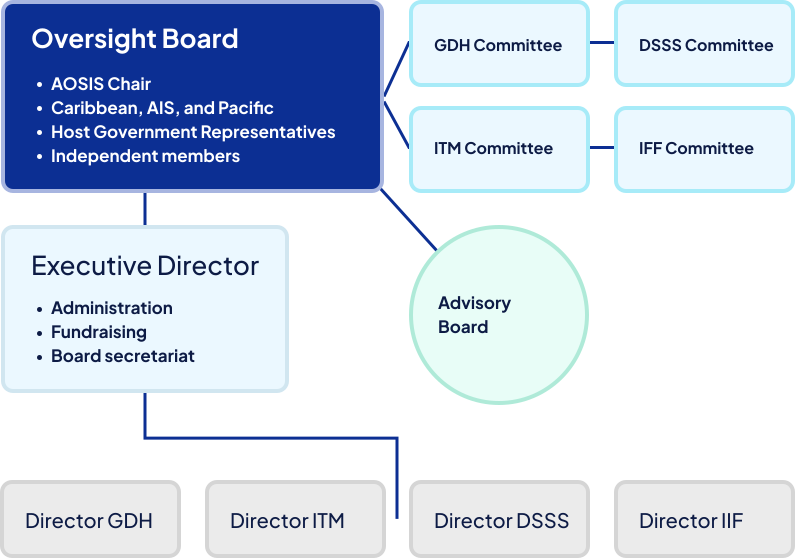
Management and Governance Structure
The SIDS Centre of Excellence is designed to combine the agility and innovation of leading private-sector and academic centres of excellence with the robust governance, legitimacy, and policy alignment of UN- and government-led models. This hybrid approach ensures that the Centre is both operationally effective and institutionally credible, capable of responding to immediate SIDS priorities while supporting long-term strategic objectives.
Executive Leadership and Management
The day-to-day management of the SIDS CoE will be led by a highly qualified executive team, headed by an Executive Director. The Executive Director provides overall leadership, strategic coordination, and external representation for the Centre. The Executive Director will work closely with four Directors, each responsible for one of the CoE’s core pillars. Together, this senior leadership team will ensure strategic coherence across the Centre’s technical, policy, and operational workstreams.
Pillar Leadership and Operations
Each Director is responsible for:
Oversight and Advisory Framework
The SIDS Centre of Excellence is governed through a multi-layered oversight and advisory structure designed to ensure strategic direction, accountability, and international legitimacy, while remaining responsive to the evolving needs of Small Island Developing States.
Oversight Board
Strategic oversight of the SIDS CoE is provided by an Oversight Board, reflecting balanced representation across SIDS regions and key institutional partners. Membership includes:
Board members serve two-year terms, renewable twice, on a rotational basis. The Oversight Board is supported by four specialised committees, each aligned to one of the CoE’s core pillars.
Advisory Board
To support higher-level strategic thinking, the Oversight Board is assisted by an Advisory Board comprising leaders from universities, think tanks, family offices, business associations from SIDS, and other relevant partners. The Advisory Board provides non-binding guidance on emerging issues, innovation, and long-term positioning of the Centre.
Private Sector Engagement (Consultative)
To strengthen pillar-specific expertise and partnerships, the SIDS CoE may establish Private Sector Advisory Groups. These consultative bodies, composed of industry leaders, technical experts, and investors, will provide insights aligned with the Centre’s mission, without decision-making authority. This approach supports strong public–private collaboration while safeguarding institutional integrity.


